|
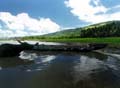
Laguna de Bay is the Philippines'
largest inland water body covering 98,000 hectares and situated at the
heart of the CALABARZON (includes the provinces of Cavite, Laguna,
Batangas, Rizal And Quezon) area - the region's highly urbanized and
developed center. The lake is bounded by six (6) provinces, twelve
(12) cities, and forty-nine (49) municipalities, of which are lakeshore
towns. A total of twenty-four (24) sub-basins drain directly to
the lake, with the Pagsanjan-Lumban Rivers System contributing to as
much as 35% of the total inflow to the lake.
(Laguna Lake Development Authority)

Importance of
Laguna de Bay
|
1. |
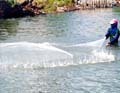
The lake is a major lifeline for most of the countryside
townspeople. Fisheries is still the lake's most dominant
use as of the present, with an estimated annual potential yield
of 80,000 to 90,000 MT for both fishpens and open water
fisheries. Croplands in the lakeshore towns, aside from
feeding locals, contribute significantly to the food supply of
Metropolitan Manila. |
|
2. |
Many workers in the Metropolitan Manila area take up residence
in the nearby lakeshore towns, notably San Pedro, Calamba, Los
Baņos, Taytay, Pateros and Binangonan, to name a few. Not
only are the residential developments in these areas more
affordable, they are also relatively more peaceful and less
polluted compared to the big city. |
|
3. |
Laguna de Bay provides a major transport route that makes
mobility within the lake and around lakeshore towns easier.
The lake also serves as a reservoir for floodwaters to save
Metropolitan Manila from flooding during the rainy season.
The Manggahan Floodway was constructed to divert floodwaters
from Marikina into the lake. |
|
4. |
The waters of the lake are also used to generate power to a
limited extent. A pump storage hydroelectric power station
is operated in Kalayaan, Laguna producing about 300 megawatts of
electricity. Efforts are underway to increase this
capacity to 600 megawatts. The Lake offers sufficient
water for a year round source of irrigation for farmlands in the
Laguna de Bay area. However, these areas targeted for
irrigation are rapidly being converted into industrial and
residential land use. |
|
5. |
At present, the lake is also a source of domestic water supply
although on a very limited basis. In the long term,
however, Laguna de Bay is being considered as a major resource
that will help supply the domestic water requirements of nearby
towns. In fact, it could be considered as the only
alternative source of domestic freshwater for southern Manila
provinces. |
|
6. |
Laguna de Bay inspired a rich culture and a wealth of traditions
in the lakeshore communities. The area is proud of its
heritage which evolved through centuries of varied cultural
influences. The most prominent son of the lake is the
country's national hero, Dr. Jose Rizal, who was born in Calamba,
Laguna. Laguna de Bay was romanticized in his two novels
which sowed the seeds of independence from the Spanish
conquerors. |
|
7. |
Laguna de Bay is home to a variety of organisms that comprise
its biodiversity pool. Of note are the 31 species of
fishes, 154 species of phytoplankton, 36 species of zooplankton,
and 24 species of macrophytes. Other organisms thriving in
the lake include different species of mollusks, crustaceans, and
birds that feed on the lake's resources. |
|
8. |
The lake also serves as habitat for various species of birds.
It is believed that 17 bird species may be found in the Mount
Makiling Forest Reserve, while 20 species can be found in the
Pakil and Real areas. These are restricted-range birds of
the Luzon endemic-area.
(Haribon Foundation) |
|
|
- by Amy M. Lecciones |
 |
Basic Information |
|
surface area: |
900 sq.km. |
average
depth: |
2.5 meters |
greatest
depth: |
20 m (Diablo Pass) |
watershed
area: |
283,000 hectares |
|
shoreline: |
238 km |
retention
time:
|
7 months |
Uses |
|
1. |
aquaculture and
fisheries |
|
2. |
water for
irrigation |
|
3. |
transport route |
|
4. |
power generation |
|
5. |
water sink |
|
6. |
industrial cooling |
|
7. |
recreation |
8.
|
domestic use |
The 29 Lakeshore Towns
1. Bay
2. Biņan
3. Cabuyao
4. Calamba
5. Calauan
6. Kalayaan
7. Los Baņos
8. Lumban
9. Mabitac
10. Paete
11. Pakil
12. Pangil
13. Pila
14. San Pedro
15. Santa Cruz
16. Santa Rosa
17. Siniloan
18. Victoria
19. Angono
20. Baras
21. Binangonan
22. Cardona
23. Jala-Jala
24. Morong
25. Pililla
26. Tanay
27. Taytay
28. Muntinlupa
29. Taguig
Source: LLDA
|
The 24 Sub-Basins
1. Angono
2. Baras
3. Biņan
4. Calauan
5. Caliraya
6. Jala-Jala
7. Los Baņos
8. Manggahan
9. Marikina
10. Morong
11. Muntinlupa
12. Pagsanjan
13. Pangil
14. Pila
15. Pililla
16. Siniloan
17. San Cristobal
18. San Juan
19. San Pedro
20. Santa Rosa
21. Santa Cruz
22. Santa Maria
23. Taguig
24. TanaySource:
LLDA
|

 |