|
The Philippines has
4 wetlands which are declared
Ramsar sites. The Olango Island in Lapu-lapu, Cebu
(5,820 hectares) is used by millions of shorebirds as a resting place enroute from Siberia
and northern Japan to Southeast Asia and Australia. These migratory birds come to this
waterfowl haven to escape the fierce winters in northern Asia. Each year Olango sees
nearly a hundred different species of birds, a number of which are migratory.
Among the frequent guests are Chinese egrets, Asiatic dowitchers, Eastern curlews, plovers, and
sandpipers.
Naujan Lake National Park
in Oriental Mindoro (14,568 ha) is the fifth largest lake in the Philippines (14km by
7km); it is volcanic in origin and receives water from local run-off with no major
effluents. There are large areas of shallow water with an abundant growth of aquatic
vegetation. Most of the people in the area depend upon the lake for their
livelihood, particularly through fishing.
The
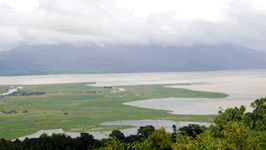
Agusan Marsh Wildlife Sanctuary
(14,836 ha) includes a vast complex of freshwater marshes and water-courses with numerous shallow
lakes and ponds in the upper basin of the Agusan River and its tributaries, which rise in
the hills of eastern Mindanao. Some parts of the marsh have been converted into fish
ponds and rice paddies. The site acts as storage for rain water and reduces the
immediate downstream flow of flood water into Butuan City and other population centers.
Tubbataha Reefs National Marine Park
(33,200 ha), located in the middle of the Central Sulu Sea about 150 kilometers southeast of
Puerto Princesa City, is well-known amongst fishermen in the southern Philippines and
scuba divers around the world. Some 46 coral genera and more than 300 coral species
have been recorded, as well as at least 40 families and 379 species of fish.
Sea turtles, sharks, tuna, dolphins, and jackfish are also found in the reefs. The Park was
inscribed in UNESCO's World Heritage list in 1993.
|
|
Location : Province of Agusan del Sur
Agusan Marsh is the largest and the least disturbed freshwater wetland
in the Philippines. It holds the largest remaining population of
Crocodylus poposus and Crocolylus mindorensis in the country.
It has vital importance in its flood control and sediment retention functions.
LINKS:
APO REEF
|
Location : Municipality of Sablayan,
Province of Occidental Mindoro
The largest coral atoll in the Philippines,
is a 3-meter deep channel with fine white sand bottom, numerous mounds and patches of
corals separating the reef also makes it particularly unique.
LINKS:
BALAYAN BAY
|
Location : Batangas Province
Balayan Bay is a diverse range of coastal
ecosystems which includes seagrass beds, fringing reef and extensive mudflats.
LINK:
LAGUNA DE BAY
|
Location : Provinces of Rizal and Laguna
Laguna de Bay is the most important
freshwater wetland in the Philippines in terms of support to local communities. However,
it is now threatened with inappropriate various development projects and over-exploitation
of its resources.
LINKS:
BUGUEY WETLANDS
|
Location : Buguey, Cagayan Province
This very diverse coastal ecosystem,
consisting of brackish lagoon, freshwater marshes, mangroves and intertidal mudflats, is
an important area for migratory waterfowl, especially ducks and shorebirds.
LINK:
CABULAO BAY
|
Location : Tagbilaran City, Bohol
This very diverse coastal ecosystems,
consisting of shallow sea with offshore inlands, mangroves, rivers, estuaries and
mudflats, is one of the least disturbed coastal areas in the province of Bohol. The
endangered Crocodylus porosus is found in this bay.
CANDABA SWAMP
|
Location : Provinces of Bulacan and Pampanga
The Candaba Swamp has been recommended to
be protected (under the Ramsar Convention evaluation) due to its importance in the flood
control for the downstream Pampanga River. It also serves as a staging and wintering area
for ducks and egrets.
LINK:
Location : Mount Malindang, Misamis Occidental
Lake Duminagat is a
crater lake located in Mt. Malindang Natural Park, which is one of the
Protected Areas in the Philippines. The Park represents the
flora and fauna of the Zamboanga biogeographic zone.
LINKS:
INABANGA COAST
|
Location : Inabanga, Bohol
One of the largest areas of mangrove in
Bohol is found in Inabanga Coast. It is the wintering area for the rare Asiatic Dowitcher
(Limnodromus semipalmatus).
LINK:
LAKE LANAO
|
Location : Lanao del Sur Province
Lake Lanao is said to have around 18
species of cyprinid fish endemic to the lake.
LINK:
Location : Mount Malindang, Misamis Occidental
Langaran River
is located in the northeastern part of Mt.
Malindang, a mountain range that became a National Park in
1971 by virtue of Republic Act No. 6266. The river plays a
vital role in the economy of the surrounding municipalities. Aside
from being the domestic abode of many communities, vast farmers are
dependent on the irrigation waters from the three dams built along it.
LEYTE SAB-A BASIN
|
Location : Province of Leyte
The basin is a
90,000-hectare of herbaceous swamp, with small lakes and ponds. It is known
to be a staging and wintering area for egrets and ducks.
LINK:
LIGUASAN MARSH |
Location : South Cotabato Province
The largest marsh in the Philippines is the
home of a considerable population of Crocodylus poposus and Crocolylus
mindorensis.
LINKS:
MALAMPAYA SOUND
|
Location : Taytay, Palawan
One of the largest remaining areas of
relatively undisturbed mangrove forest in the Philippines is found in the inner Sound.
This is also one of the most important fishing grounds in the country.
LINKS:
Location : Cavite City and Balanga, Bataan
The bay has of vital importance to
subsistence fishing for communities around Metro Manila, undoubtedly the most important
wetland in socio-economic terms. It has been threatened by massive pollution by domestic
and industrial wastes, and over-exploitation of its resources.
LINKS:
|

LAKE MANGUAO
|
Location : Taytay, Palawan
The only lake in the province of Palawan
which has at least three species of fish endemic to the lake. Lake Manguao is probably the
least disturbed lake in the country with catchment area of high quality monsoonal forest.
LINKS:
NAUJAN LAKE |
Location : Oriental Mindoro
The lake has very diversity of fish
species, and an important staging and wintering area for large number of ducks.
LINKS:
Location : Mactan Island, Cebu City
The island is one of the most important
staging areas identified for the migratory shorebirds in the Philippines. Recorded as the
most important site for the rare Asiatic Dowitcher (Limnodromus semipalmatus). The
island has mangrove, offshore coral reefs, and extensive coralline sandflats and seagrass
beds.
LINKS:
PANGUIL BAY
|
Location : Provinces of Misamis Occidental and Zamboanga del Sur
The bay, which has an extensive mangroves,
is a very important area for support of local communities. Migratory shorebirds, Chinese
Pond Heron (Ardeola bacchus) and little egret (Egretta garzetta) are found
in this area.
LINKS:
Location : Ilocos Norte
The lake covers 387.5 ha.
with five barangays sharing its coastline. It is a natural body of
fresh water without tributaries. It's deepest part is 7.5 m and the
most shallow is 3 - 5 meters.
PUERTO PRINCESA
SUBTERRANEAN RIVER
|
Location: Province of Palawan
A World Heritage site, and one of the longest navigable underground rivers in the world
which features cathedral-like caverns and domes. This underground river is home to
other cove dwelling fauna.
LINK:
Location : Provinces of South Cotabato and Sultan Kudarat
The watershed of Lake Sebu is recognized as one of the most important watershed areas
in the country. The 92,450-ha landscape was proclaimed as a Protected Landscape on
24 September 1985.
LINK:
Location : Surigao City (Surigao del Norte)
The most extensive mangrove forest in the
country, which support to a large number of human population, is found in this island.
LINKS:
Location : Taal, Batangas
Taal Lake has one of the highest levels of
diversity of migratory fishes of any lake in the country. It also has high scenic values
and is important in tourism.
LINKS:
TALABONG ISLAND & BAIS BAYS
|
Location : Dumaguete City (Negros Oriental)
A mangrove island in a bay, making the area
so different to other bays, and with extensive mudflats which support many species
invertebrates and fishes. Large number of ducks, herons and egrets use the island as a
feeding area.
LINK:
Location :
General Luna, Quezon Province
The bay includes a vast areas of mangrove
and extensive intertidal mudflats. It is known to be the staging and wintering area for
migratory herons, egrets and shorebirds.
LINK:
Location : Province of Palawan
Located at 150 kilometers southeast of
Puerto Princesa City, this national marine park is well-known amongst fishermen in the
southern Philippines and scuba divers around the world.
LINKS:
Location : southwestern tip of the Philippines, between Philippines and Malaysia
Turtle Islands, aprotected area since 1996,
is a major nesting site of the endangered green sea turtle (Chelonia mydas).
The different islands exhibit varied vegetative cover; its vast water area supports
diverse species of fish and other marine invertebrates of very high commercial value.
LINKS:
ULUGAN BAY
|
Location :
Province of Palawan
A large area of high quality mangroves is
found in the inner part of the bay. It represents one of the very few remaining areas of
old-growth mangrove in the country.
LINKS:
|